Sammamish Hasn't Decided Where Its Next 2,000 Homes Go, and the Vote Is This Fall
September 24, 2026
September 24, 2026
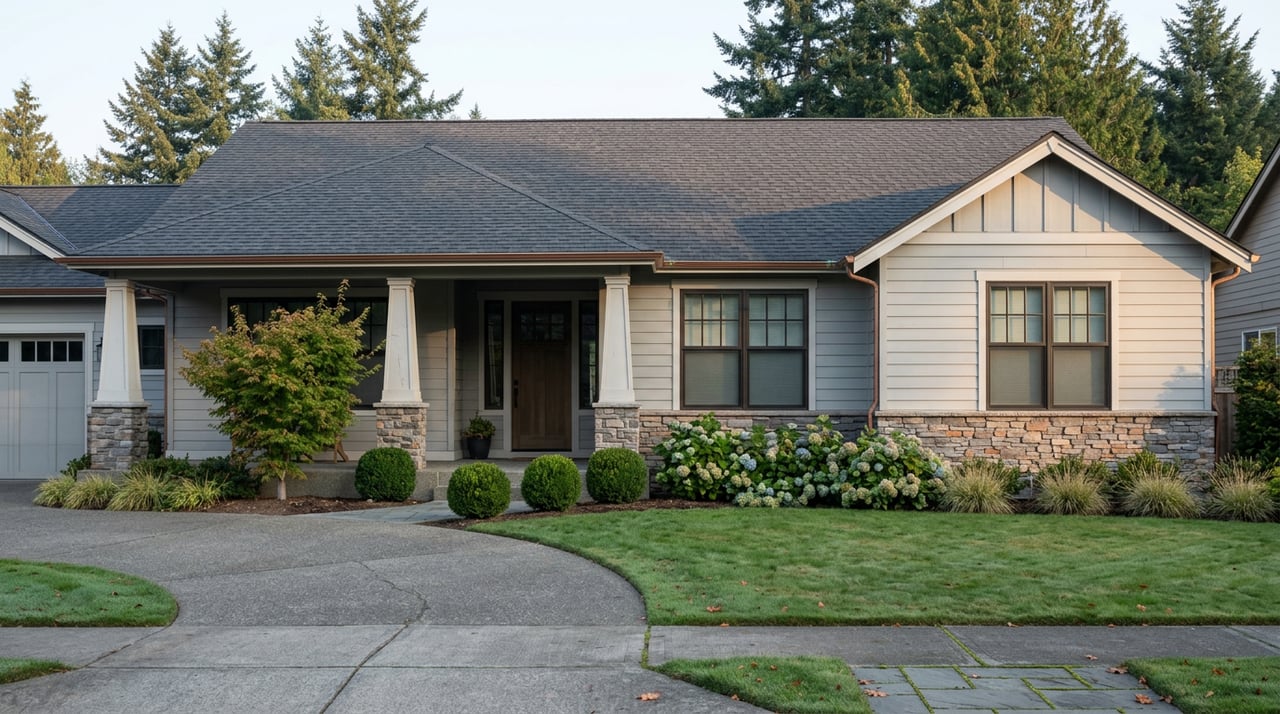
Every Sammamish listing you've looked at lately probably came with the same subtext: townhomes clustering near Metropolitan Market on one side, quarter-acre lots out toward the Plateau and Trossachs on the other. The assumption baked into that split is that the Town Center will keep absorbing the city's growth and the established single-family neighborhoods will stay mostly as they are.
That assumption is currently up for a vote. Not a metaphorical one. An actual council decision, expected this fall, that could send Sammamish's future housing growth somewhere else entirely.
Sammamish adopted its original Town Center plan in 2008 with a cap of 2,000 housing units across roughly 240 acres bounded by East Main Street, Southeast 8th Street, 233rd Avenue, and 222nd Street. The idea was straightforward: put the density where the infrastructure could support it, and let the rest of the city stay lower-scale.
It didn't work that way. Since 2008, only 326 units have actually been built inside the Town Center planning area. Meanwhile more than 3,500 homes went up across the rest of the city, almost entirely as single-family subdivisions on individual lots. The city's own Community Development Director has pointed to this exact pattern as the reason the 2008 plan needed revisiting: when growth doesn't land in Town Center, it lands as infill everywhere else.
That matters for anyone comparing a Town Center address to a resale in an established neighborhood right now, because the entire premise behind that comparison, that one side takes the growth and the other side doesn't, is precisely what the current city council is reconsidering.
In July 2025, the Sammamish City Council voted 6-1 to study raising the Town Center's housing cap from 2,000 units to 4,000, adopting what the city calls "Action Alternative 1." The package included a hybrid form-based zoning code, a streamlined permit process, and new streets and bike lanes designed to support the added density. Then the timeline turned political.
| When | What Happened |
|---|---|
| July 15, 2025 | Council votes 6-1 to study the 4,000-unit alternative |
| November 2025 | Election seats three explicitly growth-skeptical councilmembers |
| Late 2025 | City pauses all Town Center Amendment work pending new council direction |
| January 2026 | New council seated; Josh Amato selected as mayor |
| July 2026 | Council unanimously drops pursuit of a "regional growth center" designation |
| Mid-August 2026 | Council votes 5-2 to raise the single-family affordability-fee threshold from 1,500 to 1,750 square feet |
| Fall 2026 | Council expected to decide the fate of the 4,000-unit study |
The November 2025 election became a referendum on that single vote. Debbie Treen, Michael Boyer, and Josh Amato all campaigned in explicit opposition to the 4,000-unit study, and Amato's own campaign site carried a banner reading "Josh is opposed to the 4,000 unit upzone in the Town Center." Incumbent Amy Lam held her seat only through a write-in campaign that split the opposition vote. Once seated, the new council froze the Town Center Amendment project outright, with the city's own project page stating the work was paused until the council provided new direction at its February 2026 retreat.
The council hasn't issued a final ruling on the 4,000-unit question yet, but it has taken three actions this year that point toward its direction:
Read together, these are not neutral procedural moves. They loosen the constraints on single-family construction at the same time they slow the process that would have added density to Town Center.
Sammamish isn't free to shelve growth altogether. Under Washington's Growth Management Act and the 2021 House Bill 1220, the city has to show it has zoned capacity for roughly 2,100 additional housing units by 2044, the majority of them affordable to lower-income households, a target set through King County's regional planning process. Right now the city is meeting that obligation partly by assuming that publicly owned and religious-institution parcels will redevelop with affordable housing under its inclusionary zoning rules, a strategy that depends on parcels the city doesn't control actually being sold and rebuilt.
Sammamish has also been down the non-compliance road before. A 2020 dispute over Town Center traffic standards ended in a building moratorium that extended into 2021, and the city has faced GMA rulings against it in the past. More recently, Mercer Island tested similar state housing-capacity requirements in court and lost, a precedent that could apply directly if Sammamish's new council scales the Town Center plan back too far. If that happens, the city could face another appeal under the same law it's trying to satisfy, which would add its own layer of permitting uncertainty to whatever gets built in Town Center over the next several years.
If you're looking at a Parkside or TerraLuxe-style townhome near Metropolitan Market, the pitch has always been proximity: walk to a grocery store, a library, the YMCA, without much of a commute to Bellevue or Redmond. That pitch doesn't change if the 4,000-unit study gets shelved this fall. What changes is the ceiling on how much more gets built around you, and on what timeline. A smaller Town Center means fewer future neighbors competing for the same walkable amenities, but it also means less certainty about when the retail and civic space the original plan promised actually arrives.
If you're looking at a resale on the Plateau, in Trossachs, or in Klahanie, the history here is the more useful guide than the current headline. The last time Sammamish capped Town Center growth tightly, the difference didn't disappear. It showed up as 3,500-plus single-family homes built across the rest of the city over roughly fifteen years. A council decision this fall that keeps the Town Center small doesn't reduce Sammamish's obligation to plan for new housing. Given the pattern already on record, it raises the odds that more of that growth lands as infill and redevelopment in the neighborhoods that assumed they were done growing.
Either way, this is not a decision to price around six months from now. It is being made this fall, and the outcome will shape which parts of Sammamish see new construction pressure for the next decade.
Has the council made a final decision on the 4,000-unit cap yet? Not as of this writing. The Town Center Amendment project remains paused, with a final council decision expected this fall.
Does this affect home values in Sammamish right now? The reporting so far describes policy direction and process, not a market outcome. It's a factor to understand when comparing neighborhoods, not a number to plug into a valuation today.
Where can I follow the actual vote? Sammamish City Council meetings are open to the public and posted on the city's own project pages, which is where the pause notice and retreat timeline are documented directly.
If you're comparing a Town Center address to a resale elsewhere in Sammamish, or trying to figure out which established neighborhoods are most likely to see redevelopment pressure over the next several years, that's exactly the kind of question worth working through with someone who follows this market closely rather than guessing from a portal listing. Pacific NW Houses can walk you through what a specific address is actually positioned for once this fall's decision lands.
September 24, 2026
September 17, 2026

September 10, 2026
September 3, 2026
August 27, 2026
August 20, 2026
August 13, 2026
August 13, 2026
August 6, 2026
Stacy believes real estate is about people, not just properties. She’s attentive, dependable, and deeply committed to earning your trust. With her by your side, you’ll feel supported every step of the way.
5825 221ST PL SE STE 202 ISSAQUAH WA 98027